Tuesday, February 15, 2022

SPOTLIGHT ON - RAYMOND VEN SMITH – 1896- 1981

 Ven Smith was widely known in the 1930’s – 1970’s, not only in Parsonsfield and Porter, but all over southern Maine for his home-grown music and especially for his home-made instruments.


Raymond Ven Smith was born June 17, 1896, in Burlington, MA to Robert and Julia (Coffin) Smith.  His parents died not long after he was born and he was moved to South Parsonsfield, Maine to live on the farm of James Row, a blacksmith and farmer who raised him.   He attended Parsonsfield and Newfield schools and worked his way through an agricultural course at Parsonsfield Seminary. He farmed all his life, raising Holstein cattle and had a dairy farm at one time. But music played a big part in his life as a young man.  


May 5, 1918, he married Edith (Haines) Smith. They had 4 children, Alice, Arnold, Louise and Raymond.  Edith was a schoolteacher for 44 years in Denmark and Parsonsfield.

Ven was a “home grown” music man who could coax syncopated rhythm from a flowerpot and melodies from a brass bed xylophone.  He learned to play chords from Everett Patch and graduated to country dances.  He traveled with “Jim” Cole of Cornish who further inspired him to play violin.  He was interested in music all his life and began playing instruments as a young man.  He was mostly self-taught with no formal  

musical training, but played standard instruments such as the violin, guitar, bass fiddle, banjo, mandolin, accordion, bugle, harmonica, ukulele and piano.


He became widely known for his home-made instruments.  Common articles from the kitchen, barn, garage, workshop, and attic contributed to his collection.  He created the first tin can xylophone from evaporated milk cans.  A brass bedstead became bedstead chimes. Other instruments were made from a pitch fork with two steel strings, lard keg with guitar strings, a whiffle tree, salt fish box and cheese box violins, wash pan banjo, cow horns, wash board and fireplace bellows.  And of course, a musical saw.


His children and grandchildren inherited his musical ability.  The family used to entertain at dances when the children were small.  They formed the singing group the “Singing Smiths” but stopped when the children grew up and lost interest. 


He did musical comedy and in 1956 put on his musical show at a Portland hotel.

He played with a group at dances every Saturday night at West Baldwin. He played the musical saw in churches and made appearances before club groups. 


In 1962 Ven was chosen to represent the Pine Tree State on national TV on the Ted Mack’s Original Amateur Hour.   


Nov. 7, 1969, he won 1st prize - a trophy, and $50 in the senior division of the Northeast Regional Old Time Fiddlers Contest in Montpelier, VT.  


Whether playing in a group for a dance, putting on an entertainment, playing for friends 

or for his own satisfaction he was happiest when he was with music.  He said, “There is music all around us if we’d only listen for it.”


Along with farming and playing at dances, and musical appearances he served on the Parsonsfield School Board for 19 years and was a bus driver for a number of years.

He was a member of the West Newfield Congregational Church and charter member of the Parsonsfield-Porter Historical Society.


His wife, Edith died August 20, 1966 and Ven died in Palm Beach Florida Nov. 13, 1981.  They are buried at the Maplewood Cemetery in Parsonsfield.


Monday, January 31, 2022

SPOTLIGHT ON NOTABLE PARSONSFIELD RESIDENT - ALICE E. GRANVILLE

 Alice Granville was an active and well known resident of Parsonsfield for all her adult life.  She was born in Brownfield, Maine July 15, 1884; daughter of David S. and Anne Elizabeth (Staples) Fogg.

January 1, 1903 she was married to Harvey E. Granville who was also active in Parsonsfield town affairs, the first principal of Porter High School at Kezar Falls in 1920 and served in both houses of the Maine State Legislature.  

They had a son, Harry F. Granville born in 1903.  In 1911 they moved to reside on Elm Street in Kezar Falls Village, Parsonsfield.  Her husband passed away on August 18, 1948. 


Alice was active in many state and local organizations.  She became a member of the Ladies Magazine and Reading Club in 1905 and became a member of the Kezar Falls Circulating Library Association the same year.  She served as its librarian for several years.


When the Kezar Falls Branch, American Red Cross was organized in 1917, she served as its first secretary with Mrs. Bessie Stearns Johansen.  In 1945 she also became active in the work of the Salvation Army serving as Kezar Falls treasurer and was Chairman of the welfare committee in that area for many years.


From 1925 – 1945 Alice was president of the York County Tuberculosis and Health Association and was honored by them in May 1964 for her part in a statewide effort to improve personal health.


Previous to 1928 she was made a member of the executive board of the Maine Public Health Association, serving for many years.  She also served as chairman of the health committee of the Maine Federation of Women’s Clubs for two years and was the first treasurer of the Women’s Legislative Council.


She was best known as the Parsonsfield Town Clerk where she served from 1938 to 1964, was Registrar of Voters and held the office of Excise Tax Collector for a number of years. Alice passed away April 14, 1982 at the age of 98 and is buried in the Kezar Falls Burial Grounds Cemetery.


Friday, January 14, 2022

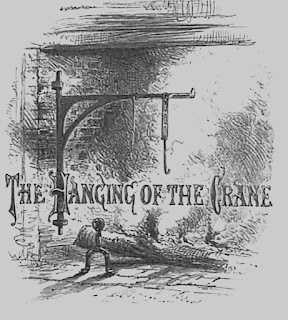
Hanging the Crane

 While doing genealogical research of the Merrifield family, Sylvia Pease came across this ceremony practiced by early settlers.  According to Gideon Ridlon’s account in “Saco Valley Settlements and Families” the story goes as follows…….

Having put up their log houses the previous year and in the autumn after securing their harvests and a new fall of snow, Levi Merrifield and his brother-in-law John Kennard packed all their household belongings on a common ox-sled, seated their two young wives upon it and began their journey to settle in the wild lands of Limington (then known as the plantation of Little Ossipee).  Arriving late the second evening, “Here in the wilderness, surrounded by towering hills the brief ceremony of “hanging the crane” was attended to and full of courage, vim and health these young people began life in earnest.” 


The ceremonial hanging of an iron crane (a potholder mounted to the wall of a fireplace for cooking) symbolized the making of a home – whether a new home as described above, or when newlyweds set up their first home.


In 1874 Henry Wadsworth Longfellow wrote about this in his poem - “The Hanging of the Crane”.  In his poem – having performed this task in the home, the newlywed couple celebrated with family and friends with merriment and jests.  The wedding guests depart leaving the fatigued couple alone before their newly renovated hearth contemplating family and the future.


It is a very long poem. The first stanza included here describes the ceremony.  To read the whole poem just google the title.


The lights are out, and gone are all the guests

That thronging came with merriment and jests

  To celebrate the Hanging of the Crane

In the new house, -- into the night are gone;

But still the fire upon the hearth burns on,

  And I alone remain.


O fortunate, O happy day

When a new household finds its place

Among the myriad homes of earth,

Like a new star just sprung to birth,

And rolled onto its harmonious way

Into the boundless realms of space!

So said the guests in speech and song,

As in the chimney, burning bright

We hung the iron crane to-night,

And merry was the feast and long.

Friday, December 31, 2021

To all members and friends of the Parsonsfield-Porter Historical Society, Best Wishes for 2022.


This charming New Year's card from 1920 expresses our New Year's greeting for all of you.  We look forward to 2022 with hope and enthusiasm.  Stay safe and well.  Come see us at History House in the Spring!


Wednesday, December 15, 2021

"Yes, Virginia, there is a Santa Claus."

 In the spirit of the season, we’d like to present this Christmas letter written on September 21, 1897, by the editor of the Sun (now known as The New York Sun) that has become part of a popular Christmas folklore in the US.  Though unsigned, the editorial was written by Francis Pharcellus Church, one of the newspaper’s editors in answer to a question from Virginia O’Hanlon.  Hope you enjoy it as much as the original readers did!

We take pleasure in answering at once and thus prominently the communication below, expressing at the same time our great gratification that its faithful author is numbered among the friends of The Sun:


“Dear Editor,

I am eight years old.  Some of my little friends say 

there is no Santa Claus.  Papa says, ‘If you see it in The Sun 

it’s so.’  Please tell me the truth; is there a Santa Claus?

Virginia O’Hanlon

15 W. 95th St.”


Virginia, your little friends are wrong.  They have been affected by the skepticism of a skeptical age.  They do not believe except [what] they see.  They think that nothing can be which is not comprehensible by their little minds.  All minds, Virginia, whether they be men’s or children’s are little.  In this great universe of ours man is a mere insect, an ant, in his intellect, as compared with the boundless world about him, as measured by the intelligence capable of grasping the whole of truth and knowledge.


Yes, Virginia, there is a Santa Claus.  He exists as certainly as love and generosity and devotion exist, and you know that they abound and give to your life its highest beauty and joy.  Alas! How dreary would be the world if there were no Santa Claus.  It would be as dreary as if there were no Virginias.  There would be no childlike faith then, no poetry, no romance to make tolerable this existence.  We should have no enjoyment, except in sense and sight.  The eternal light with which childhood fills the world would be extinguished.


Not believe in Santa Claus!  You might as well not believe in fairies!  You might get your papa to hire men to watch in all the chimneys on Christmas Eve to catch Santa Claus, but even if they did not see Santa coming down, what would that prove?  Nobody sees Santa Claus, but that is no sign that there is no Santa Claus.  The most real things in the world are those that neither children nor men can see.  Did you ever see fairies dancing on the lawn?  Of course not, but that’s no proof they are not there.  Nobody can conceive or imagine all the wonders there are unseen and unseeable in the world.


You may tear apart the baby’s rattle and see what makes the noise inside, but there is a veil covering the unseen world which not the strongest man, nor even the united strength of all the strongest men that ever lived, could tear apart.  Only faith, fancy, poetry, love, romance, can push aside that curtain and view and picture the supernal beauty and glory beyond.  Is it all real?  Ah, Virginia, in all this world there is nothing else real and abiding.


No Santa Claus!  Thank God! He lives, and he lives forever.  A thousand years from now, Virginia, nay, ten times ten thousand years from now, he will continue to make glad the heart of childhood.


More About Virginia O'Hanlon:


She was born Laura Virginia O'Hanlon on July 20, 1889 in New York City. Virginia was married for a time in 1910 to Edward Douglas by whom she had a daughter, Laura Temple.


She graduated from Hunter College with a Bachelor of Arts in 1910, received a Master's degree in education from Columbia University in 1912 and earned a doctorate from Fordham University. Virginia went on to work as a teacher and principal in the New York City school system for forty-seven years, retiring in 1959. She was dedicated to the idea that all children, regardless of social background, should have the same educational opportunities and worked her whole life toward that goal.


Throughout her life as an educator and activist for children's rights, Virginia O'Hanlon continued to receive mail from people around the world, curious about her famous letter. In her replies she always included a copy of Francis Pharcellus Church's editorial. Virginia is quoted as saying, "All I did was ask the question, is there really a Santa Claus? I did not do anything special. Of course, Mr. Church's editorial was so beautiful (that) everyone remembered his words. It was Mr. Church who wrote the famous letter." We know that Virginia did something wonderful too.


Virginia died on May 13, 1971 at the age of 81 at a nursing home in upstate New York. Her legacy lives on.


Happy Holidays to one and all from the

Parsonsfield-Porter Historical Society!


Tuesday, November 30, 2021

 WHAT’S IN A FAMILY NAME?


When the various holidays come around this time of year, families tend to gather or reach out to get in touch with each other.  Have you ever wondered about the origins of your family’s name?  This article published by the St. Louis Genealogical Society provides some insight on the subject of surnames and how many were derived from occupations.


OCCUPATIONAL SURNAMES


Most genealogists know that early people had only given names. When communities were small, there likely was just one John and he lived near the church on a hill or one Mary, and she was little. However, by the time of the Middle Ages, villages had become more populated, and calling someone just John or Mary now became problematic. As a result, names became more specific so one person could be separated from another. Now, John’s name may have transitioned into John Churchill and Mary might have become Mary Little, to distinguish them from the John near the mouth of two rivers (John Rivers) or the Mary who had long white hair (Mary Whitehead). This didn’t just happen to English names, of course. You will see the same thing occurring in most other languages.


Geographical surnames were expanded by surnames derived from a father or mother’s name. Now, John, son of John, might be John Johnson, and Mary, daughter of Agnes, might, in the Middle Ages in England, become Mary Anotdoghter.


Piper, Miller, Weaver, Shoemaker, and Gardener are just a few examples. And these names appear with their equivalents across Europe. Since blacksmiths were so important everywhere, the fact that we have smiths in so many languages shows just how dominant that occupation was throughout the world.


Most of us have occupational names in our family trees, no matter where our family originated. Your first German Lederer was probably a leather worker, same as an English Tanner or a Jewish Garber/Gerber. Your early French Ferrier and your Italian Ferraro were both likely blacksmiths; their names translate to Smith, just as the German Schmidt does. 


Here are just a few common surnames that might give you a clue as to what your ancestors did for a living:


Bailey: bailiff

Barker: shepherd or tanner

Baxter: female baker

Clark: clerk

Coleman: someone who gathered charcoal

Collier: coal miner

Cooper: barrel maker

Faulkner: falcon trainer

Hager: woodcutter

Keeler: bargeman

Kellogg: hog breeder/slaughterer

Kemp: warrior, champion (perhaps at wrestling or jousting)

Mercer: merchant, especially of fine cloth

Parker: gamekeeper

Redman: roof thatcher

Salzman: salt merchant

Schumacher, Sandler, Schuster: shoemaker

Scully: town crier

Todd: fox hunter

Travers, Travis: toll-bridge collector

Ward: watchman, guard

Webb/Webster: weaver (male and female versions)


There are many more occupational surnames in just about every language and in everyone’s family tree. Some will be quite familiar to you, like Miller, Tailor, Baker, or Bishop; others will be more challenging to decipher, such as some in the above list. 


So as you spend time with your families this holiday season, think a bit about your family’s surnames.  Do they tell you the occupation of your early ancestors?   Many came from laborers like the wagon makers (Wainwrights), barrel makers (Coopers), goat herders (Goddard), Hunters, Masons, and millions like them who came before us. 


No matter from what country your family originated, those early laborers in our families helped to define how we think of ourselves today.


St. Louis Genealogical Society, Publications@stlgs.org via gmail.mcsv.net. 


A Few More Resources:

“England Surnames Derived from Occupations, Ranks (National Institute), FamilySearch Wiki, https://www.familysearch.org/wiki/en/England_Surnames_Derived_from_Occupations,_Ranks_(National_Institute)

“German Surnames from Occupations,” Wiktionary, https://en.wiktionary.org/wiki/Category:German_surnames_from_occupations

“Occupational Surnames,” Namenerds.com, http://www.namenerds.com/uucn/listofweek/jobnames.html

 “Surnames via Occupations,” Behind the Name, https://surnames.behindthename.com/names/source/occupation


Sunday, November 14, 2021

The Parsonsfield-Porter Historical Society sends best wishes to everyone for a happy Thanksgiving with this vintage Thanksgiving card. 

  Winter is fast approaching and History House has been closed for the winter.  However, this BLOG will continue and we will replay to requests for information although our resources will be more limited when History House is not accessible.

You can contact us through our website,  www.parsonsfieldporterhistorical.org 
or by email:


Planning for 2022 meetings, programs and events will begin early next year.  If you have ideas for a program or for exhibits, please let us know.  We welcome your input.

Our next newsletter will be out next April with information on what to expect for PPHA activities in 2022.  Have a happy and healthy holiday season and a wonderful New Year and remember,


Local History Matters!